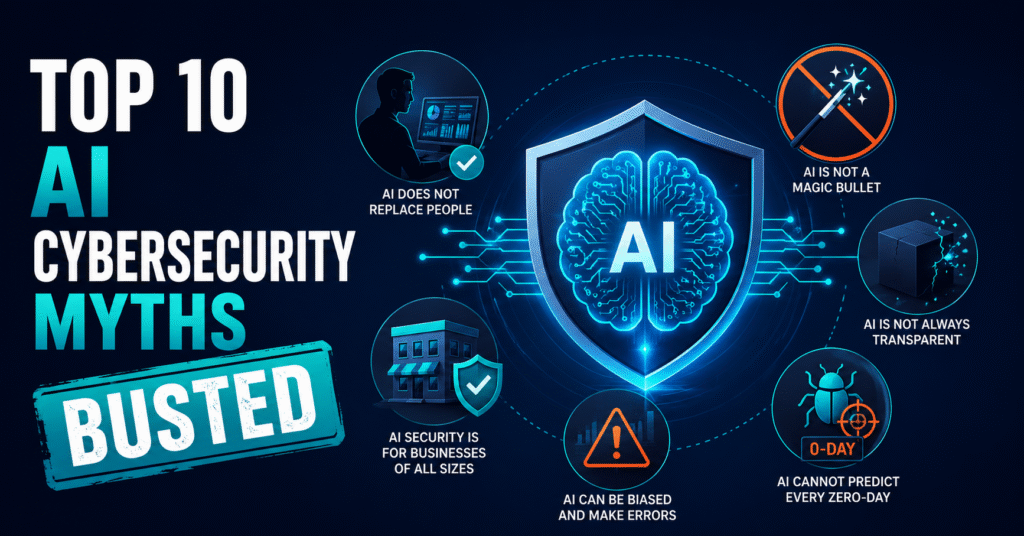
Debunking AI Cybersecurity Myths
In the rapidly evolving field of cybersecurity, artificial intelligence (AI) has become both a beacon of hope and a subject of confusion. Misconceptions abound, leading to unrealistic expectations about what AI can achieve. Here, we address some of the most common myths about AI in cybersecurity.
Myth 1: AI Will Replace Human Cybersecurity Analysts
Contrary to the belief that AI will make human cybersecurity professionals obsolete, AI serves as an augmentative tool. It handles repetitive tasks like log correlation and initial threat detection, allowing analysts to focus on complex decision-making. Human expertise is essential for interpreting AI outputs and addressing nuanced threats.
Myth 2: AI Can Automatically Prevent All Cyber Threats
While AI enhances threat detection by analyzing vast datasets, it’s not foolproof. Cyber adversaries continuously adapt, often finding ways around AI’s limitations. AI should be part of a broader cybersecurity strategy that includes human oversight and adaptive responses.
Myth 3: AI in Cybersecurity Is Fully Transparent and Explainable
Many believe AI-driven cybersecurity solutions are completely transparent. However, AI models often function as “black boxes,” making their decision-making processes opaque. Efforts are underway to create more explainable systems to enhance transparency and accountability.
Myth 4: AI Adoption Guarantees Improved Security Outcomes
Merely adopting AI doesn’t automatically boost an organization’s security. The effectiveness of AI hinges on proper integration, alignment with business objectives, and the maturity of security frameworks. Without strategic implementation, AI might offer limited benefits or introduce new vulnerabilities.
Myth 5: AI Is a Magic Bullet for Cybersecurity Challenges
AI is not a cure-all for cybersecurity issues. While it offers powerful tools, effective cybersecurity demands a multi-layered approach, including policies, training, and audits. Relying solely on AI may lead to a false sense of security.
Myth 6: AI Systems Are Immune to Bias and Errors
AI systems are not free from bias, as they are trained on existing data, which may contain inaccuracies. Regular audits and updates are necessary to identify and mitigate biases, ensuring fair and accurate operations.
Myth 7: AI Can Fully Automate Incident Response
Though AI can speed up certain response aspects, complex incidents require human judgment. Human analysts are crucial for interpreting AI findings and coordinating comprehensive responses.
Myth 8: AI in Cybersecurity Is Too Expensive for Small Businesses
AI-driven solutions are becoming more accessible to small and medium-sized businesses (SMBs). Many cost-effective tools offer scalable security measures tailored to the needs and budgets of SMBs.
Myth 9: AI Can Predict and Prevent Zero-Day Attacks
Zero-day attacks, by nature, exploit unknown vulnerabilities. While AI can detect patterns indicating potential threats, predicting such attacks remains challenging. A robust strategy must include updates and incident response planning.
Myth 10: AI in Cybersecurity Operates Without Human Input
AI requires continuous human oversight, training, and tuning to adapt to evolving threats. Human involvement ensures AI’s effectiveness and alignment with organizational goals.
AI in cybersecurity is a remarkable tool that, when properly integrated with human expertise, can significantly enhance security efforts. However, understanding its limitations and the need for a comprehensive strategy is crucial in leveraging its full potential.